
Stand In Wonder: Act II
Thursday — Passover
LENTEN SERIESPOEMS
Twelve did we number
including the betrayer
as we broke bread,
for the last time,
together.
He said the weirdest stuff—
like that the bread is his flesh?
and the wine is his blood??
that he’s “giving up”…
for us???
What?
And we should eat his flesh?
And drink his blood??
Not just this once
but from now on
to re-experience
what he says will be done???
What, what??
His riddles confuse us.
We’re simple men,
fishermen;
we just try to keep up.
—
Quiet.
We each studied the wood grain in the table before us,
unsure of anything we were sure
we were sure of, anymore.
No one dared to look up.
After a moment, Jesus rose,
slipped off his robe,
then our rabbi, our teacher,
with a towel round his waist and a basin,
looked into my eyes,
dropped to his knees,
and began washing
my feet.
“No!” I screamed.
“Yes,” he said calmly.
“When I’m no longer with you,
I need you to care
for the least of these people—
for me.
“There are so many.
“As I’ve done for you,
you now do for me.
The servant
leads.”
“But master, where are you going?”
—
“To the garden.
“My soul is crushed and pressed,
I’m overwhelmed with pain
and anguished to the point of death.
“Peter,
and James and John, my sons of thunder,
come, follow me.
I need to speak
with my Father.”
He looks so
small,
we've never seen him like this at all—
so stressed out.
He almost seems not like himself.
Then his knees buckled
and he fell.
His head slumped and,
white-knuckled, every muscle rippling,
we heard him say—
“Father, please
spare me what lay ahead
come daybreak.
Take this cup away.”
Blood-sweat fell from his forehead.
The cicadas hummed.
An angel was sent to strengthen him.
Stand in Wonder
The Passion Story in Six Acts
Act II: Thursday — Passover
Marching feet.
He turned to me:
“Get up, let’s go,
the time has come.”
Judas ran up
and with a kiss
it was done.
The soldiers arrested our Lord.
I drew my sword and
sliced that guard’s ear
clean off.
“Sheath your sword, Peter.
“This is the will of my Father.”
He healed the astonished guard on the spot
and was led off
as I, James and John,
and the betrayer—
feeling the weight
of what he had done—
all stood in wonder.
by Kim Skimmons, 4/2/2026
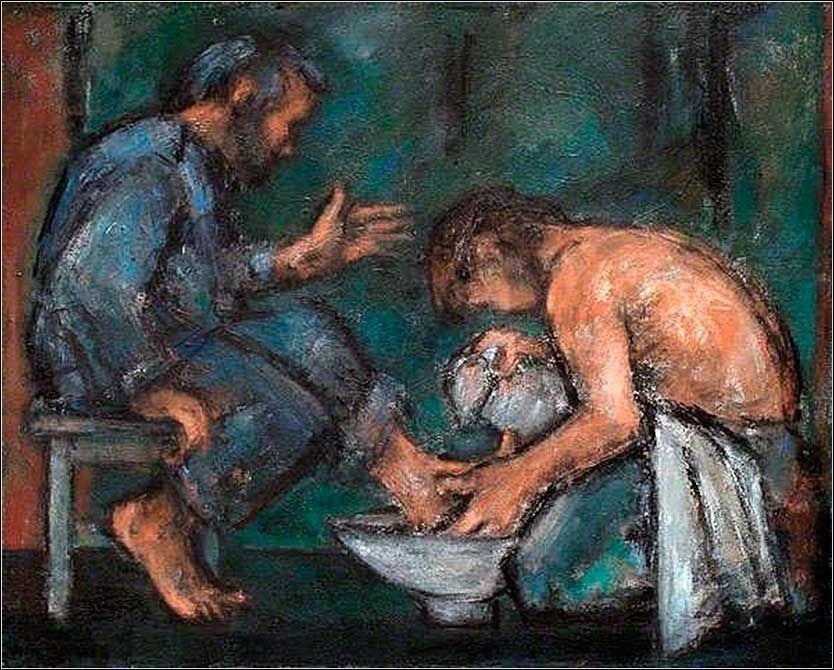
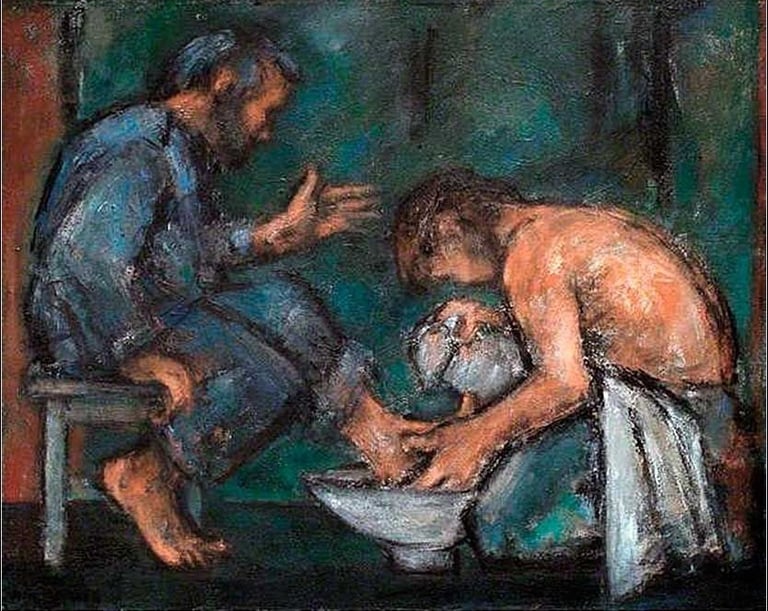
"The Washing of the Feet" by Ghislaine Howard, 2004
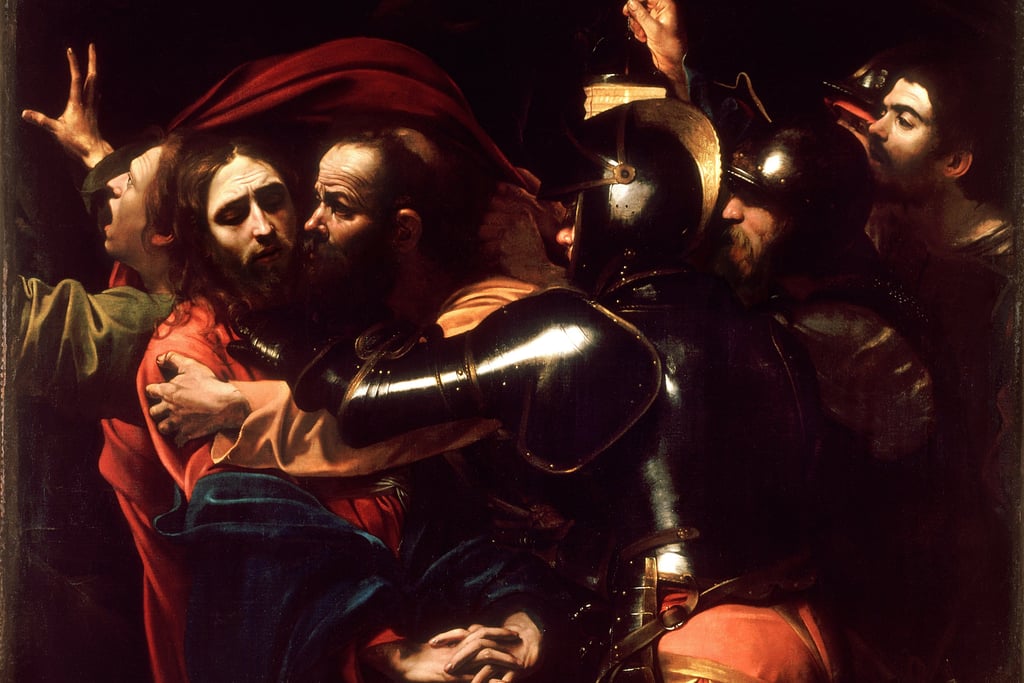
“The Taking of Christ,” Michelangelo Merisi da Caravaggio, 1602
The upper room.
So much has happened in this upper room.
Lessons, laughter, planning.
And meals. Lots of meals.
He rubs his hands over the thick wooden table, tracing the deep grain with his finger.
Then he sits down on the bench, elbows propped on the table, clasped hands holding up his head
as he takes in this last bit of silence, just remembering and thinking
The twelve will be here soon. What will he say to help them understand?
He’s been telling them for months, but they still don’t understand.
They don’t want to, and he gets it.
He asked the impossible of them, and they did it
But at great cost.
And now his time has come, and he needs to make sure they are ready to carry on without him; that they will be okay.
This plain table is where, for the last time, they’ll gather all together for a meal.
They will break bread.
They will drink wine.
But tonight, he knows the bread and wine will be different.
And they will be different because of it.
Everything will be different.
He hears noises outside, lifts his head, and rises
It’s time to prepare the Passover table.
—
The twelve arrived in twos and threes, talking, mingling,
and sensing that something was different.
When it came time to bless the meal he had prepared for them,
He took the bread, broke it, and told them things that he knew
would totally confuse them. And they did. For now.
Then he taught them the meaning of leadership
and the student not being greater than the teacher.
So many things he had yet to teach them
but there was no more time for lessons;
darkness was upon them.
It has begun.
KFS, 4/2/2026
Afterword
This sensuous work represents the first half of the evening, better known as the Last Supper. Whenever I write about the last supper, I always associate this powerful painting with it. I just love everything about it. Here's the more technical analysis:
Ghislaine Howard’s Washing of the Feet (2004) presents the Gospel scene (John 13:2–9, 12–15) with a direct and concentrated focus on the physical exchange between figures. Set against a deep green-blue ground, the composition is dominated by two bodies drawn into close proximity: Christ kneels, while the seated figure recoils slightly, hand raised in hesitation. Gesture defines the moment, as the basin, the foot, and the suspended movement between them articulate the unfolding interaction.
The work emphasizes the tension inherent in the act rather than its resolution. The reversal of roles—teacher lowered before disciple—introduces a quiet disruption, made visible through posture and spatial imbalance. The scene is rendered without idealization, foregrounding the vulnerability of both figures.
Within a Lenten or Holy Week context, the painting underscores the radical nature of service as both an offering and a challenge. The act of washing feet is shown not as symbolic abstraction but as a concrete, embodied exchange that disrupts ordinary expectations of power and dignity. In this way, Howard’s work invites reflection on humility not as a gentle virtue, but as a deliberate inversion—one that must be received as well as given, and which carries with it a quiet but unsettling force.
Links:
Methodist Modern Art Collection: https://www.methodist.org.uk/faith/the-methodist-modern-art-collection/
Ghislaine Howard: https://ghislainehoward.com/
About the Art
I've chosen two pieces to represent this high-emotion day:
1. "The Washing of the Feet" by Ghislaine Howard, 2004, Acrylic on canvas, 102 x 127 cm. © Methodist Modern Art Collection, MCMAC: 023
2. “The Taking of Christ,” Michelangelo Merisi da Caravaggio, 1602
"The Washing of the Feet"
"The Taking of Christ"
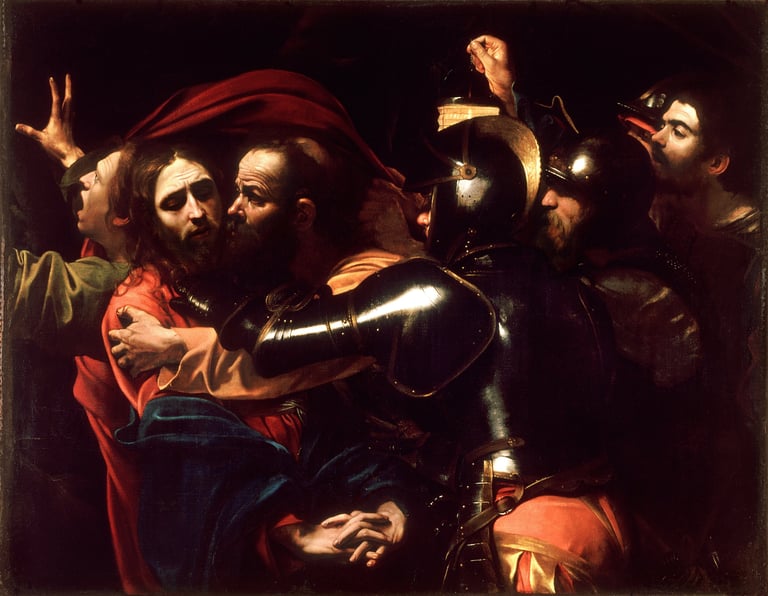
This masterpiece represents the second half of the evening, when Jesus is arrested.
“The Taking of Christ” (Italian: Presa di Cristo nell'orto or Cattura di Cristo) is a painting, of the arrest of Jesus, by the Italian Baroque master Michelangelo Merisi da Caravaggio. Originally commissioned by the Roman nobleman Ciriaco Mattei in 1602, it is housed in the National Gallery of Ireland, Dublin.
There are seven figures in the painting: from left to right they are John, Jesus, Judas, three soldiers (the one farthest to the right barely visible in the rear), and a man holding a lantern to the scene. They are standing, and only the upper three-quarters of their bodies are depicted. Judas has just kissed Jesus to identify him for the soldiers.
The figures are arrayed before a very dark background, in which the setting is obscured. The main light source is not evident in the painting but comes from the upper left; the lesser light source is the lantern held by the man at the right (believed to be a self-portrait of Caravaggio; also, presumably, representing St Peter, who would first betray Jesus by denying him, and then go on to bring the light of Christ to the world).
At the far left, a man (John) is fleeing; his arms are raised, his mouth is open in a gasp, his cloak is flying and being snatched back by a soldier. The flight of the terrified John contrasts with the entrance of the artist; scholars claim that Caravaggio is making the point that even a sinner one thousand years after the resurrection has a better understanding of Christ than does his friend.
Two of the more puzzling details of the painting are, one, the fact that the heads of Jesus and St. John seem to visually meld together in the upper left corner, and, two, the fact of the prominent presence, in the very center of the canvas and in the foremost plane of the picture, of the arresting officer's highly polished, metal-clad arm.
Regarding the detail of the polished metal arm of the soldier in the center of the picture, Franco Mormando suggests that it was meant by the artist to serve as a mirror, a mirror of self-reflection and examination of conscience (such as in Caravaggio's Conversion of Mary Madgalene in Detroit): as do many spiritual writers and preachers of the period, the artist may be 'inviting his viewers to see themselves reflected in the behavior of Judas' through their own daily acts of betrayal of Jesus, that is, through their sin.
The central group, composed of Jesus, Judas and the soldier with an outstretched hand, resembles a 1509 woodcut by Albrecht Dürer from his Small Passion series.
Source: Adapted from https://en.wikipedia.org/wiki/The_Taking_of_Christ_(Caravaggio)
"The Washing of the Feet" by Ghislaine Howard, 2004
The Taking of Christ,” Michelangelo Merisi da Caravaggio, 1602